
Why Commercial Grease Is A Different Animal
A house loads its kitchen line with the grease from family cooking, a meal at a time, with quiet hours between.
A restaurant line takes that load multiplied by covers, running from prep to close, day after day, with fryer and wash water arriving hot and carrying fat that cools against the pipe walls downstream. The line does not experience this as weather.
It experiences it as construction, a coating laying itself down at a rate set by the menu and the volume.
That is why commercial grease problems are rhythmic rather than random. The coating thickens steadily, flow narrows steadily, and the first symptom, a floor drain burping during the dinner rush, arrives at a predictable point in the buildup's growth.
The interval between a full cleaning and that symptom is the property's natural maintenance interval, and the whole game is learning it once and then servicing inside it.
What The Interval Is Based On
The honest interval is measured, not guessed. Volume is the first input: covers per day, fryers in the kitchen, hours of operation.
Line condition is the second: older cast iron and clay coat faster than smooth PVC, and a line with a known flat stretch collects at that spot ahead of schedule.
History is the third: a property that knows its line slowed badly at five months has been handed its interval by the pipe itself.
Grease traps and interceptors run on their own parallel rhythm, set by local rules and the trap's capacity, and the two schedules interact: a trap serviced late passes grease downstream into a line whose interval assumed the trap was working.
Managers who treat the trap and the line as one system, serviced on one calendar, inherit neither's surprises. The first year of a program is partly calibration, and a good contractor adjusts the interval from what the camera sees at each visit.
Keep the paperwork with the grease trap records, because the two together are what an inspector, a landlord, or an insurer asks for after anything goes wrong. A dated log showing the interval, the contractor, and what the camera found turns maintenance from a claim into a documented fact.
Kitchens that can produce that file close those conversations quickly. Kitchens that cannot are left arguing from memory, which rarely ends in their favor.

What A Maintenance Visit Looks Like
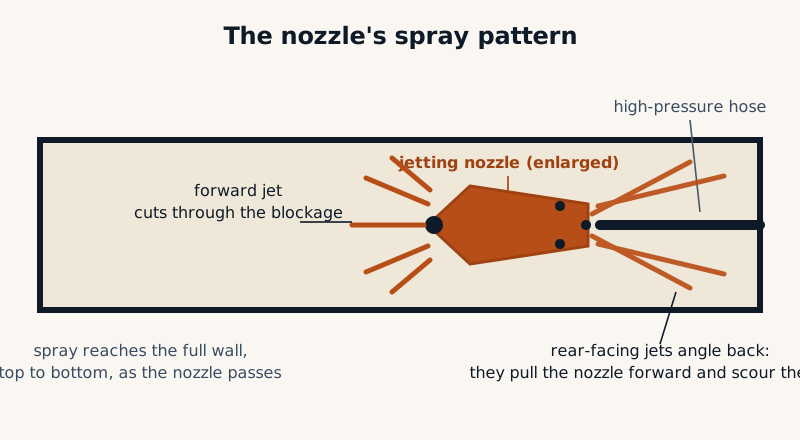
The core of the visit is jetting the run back to bare wall, the same full cleaning a main line gets, sized for the property's pipe and access.
Around that core, the visit builds the record that makes the program work: a camera pass on a rotating basis to watch the known weak spots, the trap's condition noted, any change in the line's behavior logged against the property's file.
This is the structure of commercial drain cleaning when it is run as a program rather than a series of emergencies: the clearing, the look, the note, the next date set before the crew leaves.
The visit ends with the interval confirmed or adjusted, in writing, so the manager approving it can see the reasoning instead of a recurring invoice with no memory attached.
Volume changes deserve a line in that file too. A kitchen that adds a fryer, extends its hours, or builds a catering side business is asking more of a line that was sized for the original menu.
When intervals keep shrinking despite honest maintenance, the honest conclusion may be that the line itself is now the limit. That turns the conversation from scheduling into sizing, and it starts from the same records the kitchen has been keeping all along.
The Cost Of Skipping The Rhythm
A grease line does not send a calendar invitation; it sends a backup, and it chooses the hour the way water always does, at load. For a restaurant that means a line closing during service, with the choices narrowed to an emergency call, a closed kitchen or both.
The same jetting that costs a planned hour on a quiet morning costs an evening's revenue when it happens at the rush.
There is a slower cost as well. A line that repeatedly narrows to a backup is a line whose coating gets older, harder and thicker at the walls, and eventually the maintenance conversation has to include the pipe's condition, not just its cleanliness. Intervals are not really about the calendar.
They are about never letting a solvable film become a structural fact, and never letting a maintenance line item become an emergency budget that never shrinks.
The other half of keeping a commercial line boring is what staff put into it between visits: what should never go down a commercial drain covers the short, teachable list.