Cured-in-place lining and pipe bursting: a structurally new pipe inside or along the old one's path, without trenching the whole yard. Call (941) 344-0204 to talk it through with a local drain professional.
What Trenchless Sewer Repair Is
Trenchless sewer repair rehabilitates or replaces a buried line without excavating its whole length. The two main methods are cured-in-place pipe lining, which builds a new pipe inside the old one, and pipe bursting, which pulls a new pipe through the old one's path.
For Bradenton homeowners whose sewer runs under a driveway, a lanai, mature oaks or a pool deck, trenchless methods are often the difference between a pipe project and a landscaping project.
If you are deciding between trenchless sewer repair and a bigger fix, the overview of professional hydro jetting in Bradenton explains how cleaning, inspection and repair fit together, and the sections below cover trenchless sewer repair in the depth you need before you call.
How The Work Is Done
01
Cured-In-Place Pipe (CIPP) Lining
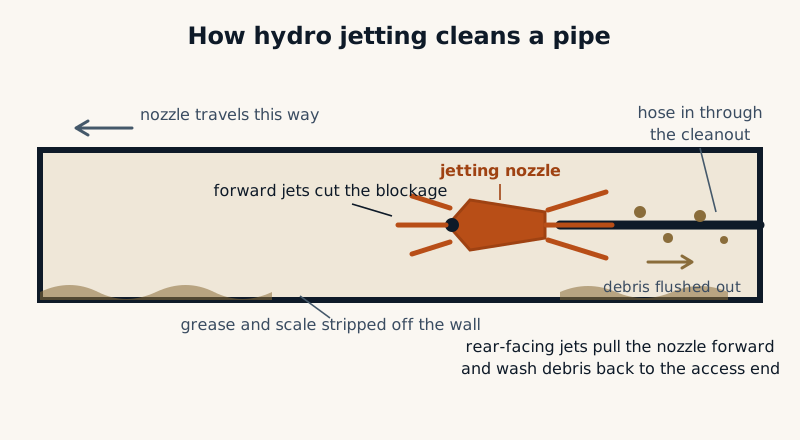
The crew first cleans the line thoroughly, usually with hydro jetting, and verifies it by camera. A flexible liner saturated with resin is then inserted through the line and inflated against the old pipe's walls, where it cures into a hard, jointless new pipe inside the old one.
Branch connections are reopened with a robotic cutter. The result seals cracks, bridges small gaps and gives roots no joints to enter, with access needed only at the ends.
02
Pipe Bursting
Where the old pipe is too deformed to line, or a larger diameter is wanted, bursting is the trenchless answer. A bursting head is pulled through the old line, fracturing it outward into the soil while towing the new pipe into place behind it.
It needs an access pit at each end rather than a continuous trench, and it fully replaces the pipe, so it suits collapsed sections that lining cannot bridge.
03
Candidacy Is Decided By Camera
Neither method is sold blind. Lining needs a host pipe that still holds a passable, roughly round path; bursting needs a pullable route. A camera inspection with locating establishes which, if either, applies to your line, and where a conventional excavated repair is actually the smarter spend.
Expect that footage conversation before any trenchless quote.
Signs You May Need This Service
The clearest signals that trenchless sewer repair belongs on your list:
Your sewer line runs under a driveway, patio, pool deck or mature trees you want to keep
The line is cracked or root-filled along much of its length but still holds its shape
Several joints leak or admit roots, though no section has fully collapsed
You have been quoted a trench and want the alternative priced honestly
Cast-iron scaling has narrowed the line and you want a smooth new bore
The yard was recently landscaped and re-digging it would be a second loss
A previous sectional repair fixed one spot while the rest of the line ages
Your pro's camera footage shows a continuous run of moderate damage
The trenchless profile is damage that is widespread but not total. Hold that picture against your camera footage and you will know which conversation you are in before the pro starts it.
Why This Problem Happens
Trenchless exists because of where sewers live.
The pipe from a Bradenton home crosses everything the homeowner values at the surface: the driveway apron, the front walk, irrigation lines, the roots of the oak that shades the house, sometimes the corner of a lanai poured decades after the pipe went in.
When those lines were clay or cast iron laid in the 1950s through 1970s, their failures now sit under fifty years of accumulated yard. Digging remains the right answer for some lines, but the surface cost of digging is what trenchless methods were invented to avoid paying.
Bradenton rewards trenchless methods more than most cities, because of what its yards hold. Mature live oaks with root plates the size of rooms shade the older neighborhoods, and their sewer lines pass directly underneath. Concrete lanais, pool decks and paver drives cover the rest.
An open trench through that landscape costs a tree, a deck or a driveway before it fixes a pipe. A liner that renews the pipe from two access points leaves all of it standing.
That is why the trenchless conversation here starts with the surface, not the pipe: walk the line's path with the pro and count what digging would actually disturb on your specific lot.
Safe Checks You Can Do First
You can prepare a real candidacy assessment from the surface. Sketch the line's likely path from house to street and list what it passes under; that list is the value trenchless protects. Find and expose your cleanout if you know its location, since lining runs from access points.
Gather any previous camera footage, which lets a pro judge the host pipe's shape quickly. And note the honest limit yourself: if a visible sinkhole or a fully caved section exists, expect excavation to enter the conversation no matter which method you prefer.
What The Professional Visit Looks Like
A trenchless visit is sequenced tightly. Camera inspection first, with measurements and locating. Then cleaning, often a full jetting, because a liner bonds against the pipe you present to it.
The liner is prepared to the measured length, inserted, inflated and cured, or the bursting run is pulled, and branch openings are reinstated. The job closes with a camera inspection of the finished line, which is both quality control and your record of the new pipe's condition.
What Affects The Cost
Trenchless pricing is per-foot work wrapped around your specific line's preparation needs. The factors are:
Factor
How It Affects The Job
Method
Lining and bursting carry different equipment and material costs per foot.
Length and diameter
Trenchless work is priced largely by the foot of line rehabilitated.
Preparation
The cleaning and any root removal needed before lining is part of the scope.
Access points
Existing cleanouts help; new access pits or an interior entry add work.
Branch connections
Each lateral connection to be reopened after lining is a step in the job.
What digging would have cost
The honest comparison includes the surface restoration a trench would demand.
Ask for the lined or burst length stated in feet on the quote, and which connections are included. Trenchless quotes are compared on scope, not on the headline.
When To Call Promptly
Do Not Wait If
Trenchless work is planned work; it follows inspection and preparation. If your line is actively backing sewage into the house, the first visit is about stabilizing and clearing, covered under <a href="/emergency-drain-cleaning/">emergency drain cleaning</a>, and the trenchless assessment happens on the evidence that visit gathers.
Frequently Asked Questions
Does Lining Shrink My Pipe's Diameter?
Slightly, by the liner's thickness, and it is almost never the deciding factor. The lined pipe's interior is smooth and jointless, so flow through it typically improves over the rough, scaled pipe it replaced, even at a marginally smaller bore.
How Long Does A Cured-In-Place Liner Last?
The materials are engineered for a service life measured in decades, and manufacturers rate liners accordingly. The practical answer also depends on the host line being properly prepared and the liner fully cured, which is what the post-installation camera pass verifies.
Can Any Sewer Line Be Lined?
No. A line that has collapsed flat, dropped into a severe belly or lost whole sections has no host shape to line. Those cases go to bursting or open excavation. The camera inspection is what sorts your line into the right method, and a straight pro will show you why.
Will Lining Stop Roots Permanently?
A lined section is jointless, which removes the openings roots entered through, so roots cannot re-enter the lined run itself. Roots can still approach unlined sections and connections, which is why the scope should state exactly which length is being lined.
How Long Does The Work Take At My Home?
Many residential lining jobs complete within a day once preparation is done, with water use restricted during curing hours. Bursting timelines depend on length and pit excavation. Your quote should include the sequence and the hours your drains will be out of service.
Is Trenchless Always The Better Choice Than Digging?
Not always. A short line under open lawn at shallow depth can cost less to dig, and a fully collapsed line may leave no choice. Trenchless wins when the surface above the line is valuable or the run is long. Insist on seeing both options reasoned from your footage.
Related Guides
From our Bradenton drain guides, the homeowner side of trenchless sewer repair, in plain language:
Both methods give you a new pipe along the old path without the trench. They differ in how the pipe is made, what happens to diameter, and which host pipes each can accept. The honest comparison.
Trenchless is not a product a line qualifies for by wanting it. Candidacy is read off camera footage: the host pipe's shape, the access, the slope. Why the honest no is a finding, not a rejection.
Read the guide →
After a lining or bursting job, the finished-line camera footage is your warranty's best friend: keep it. Also ask which exact length was rehabilitated and mark it on the same lot sketch as any remaining original pipe.
A partially lined system is a perfectly good system, as long as everyone who touches it later knows where the new pipe ends and the old one begins.
Call now and describe what your drains are doing. A drain professional who serves Bradenton will take it from there: inspect, explain, and quote the fix.