
The One System A Home Inspection Cannot See
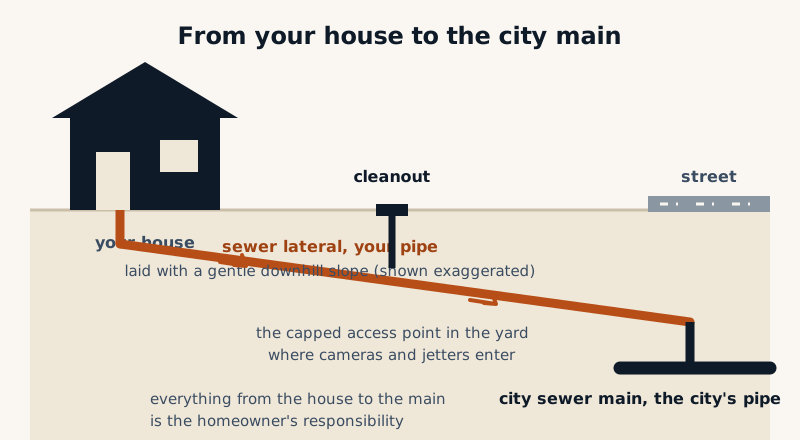
A home inspection is a tour of the visible: roof, structure, systems, fixtures. The sewer lateral fails that test completely. It is buried from the house to the street, it belongs entirely to the homeowner rather than the city, and its condition cannot be judged from a single surface clue.
A house can present beautifully with a lateral that is root-bound, cracked or quietly collapsing under the yard.
The stakes match the invisibility. Replacing a failed lateral is among the most expensive single repairs a home can need, and it arrives with excavation attached.
Buyers learned this the hard way for decades: the first backup, a month after closing, followed by footage showing a problem that clearly predated the sale. The scope exists to move that discovery a few weeks earlier, to when it can still change the negotiation.
The mechanics are flexible, which helps. A scope can run during the standard inspection period alongside the roof and the air conditioner, or be written in as a condition of the offer itself. What matters is that it happens while the result can still be acted on.
Buyers sometimes delay it to save a step if the deal falls through, and that instinct backfires: the information is only leverage while there is still something left to negotiate.
What Buyers Learn Before Closing
A scope tells a buyer which of three houses they are actually purchasing. The first has a sound line: clean footage, good slope, years of service ahead, and the unknown is simply retired.
The second has a working but aging line, scaled iron or early roots, which is not a crisis but is a maintenance future the buyer should price into ownership rather than discover.
The third has a problem with a location: a cracked section, a root-split joint, a belly holding water. Even then, the footage is leverage rather than disaster, because a located problem can be quoted precisely, and a precise quote can be negotiated, credited or repaired by the seller before closing.
What the buyer is really purchasing with a scope is the conversion of a fear into a number, and numbers are what negotiations run on.

How The Scope Fits The Purchase Timeline
The natural moment is the inspection window, alongside the general inspection, and booking works like any service call: the pro needs access to the cleanout or another entry point, an hour or so at the property, and the buyer's questions in advance.
Ask when booking whether the recording and a written summary are included; for a purchase, the paperwork is half the product.
Scheduling a camera inspection of the sewer line during the window also means the findings can be discussed while options exist: proceed, negotiate, or walk, according to the contract's terms. A scope ordered after closing can still guide repairs, but it has lost its negotiating life.
The same footage, two weeks apart, is either a fact you own or a fact that owns you, depending on when you ordered it.
Sellers can run the same play from the other side of the table. A recent scope with clean footage, filed with the disclosures, answers the question every buyer of an older home is going to ask anyway, and it removes a late surprise that can stall a closing.
Some sellers scope before listing for exactly that reason: the line's condition becomes a settled fact in the paperwork instead of a fear that grows in the dark.
Reading The Result As A Buyer
Read the footage the way the pro reads it: condition first, calendar second. Scale on sixty-year-old iron is normal aging, not a defect to panic over; it argues for a jetting and a monitoring interval in your first years of ownership.
Roots at one joint argue for a located repair or a maintenance plan. A collapsed or separated section argues for a real conversation about scope and credit, with the quote based on the footage.
And when the line scopes clean, keep the recording with your closing papers. It is the baseline every future inspection compares against, the proof of condition if a symptom appears in year three, and a document the next buyer will be glad you kept.
On an older Bradenton home, the lateral is the last invisible system. A scope makes it visible once, and the record keeps it that way.
For the full account of what the camera can and cannot establish, including the blind spots worth knowing about before you rely on any footage, read what a sewer camera actually finds, and what it cannot see.