
What The Camera Finds
The camera's home territory is the condition of the pipe's interior, and its findings read like a list of everything that makes drains misbehave. Roots, entering at joints and fanning across the bore. Grease and scale coatings, with the remaining opening measurable by eye against the pipe's known diameter.
Cracks, splits and separated joints, shown at their exact distance from the cleanout. Standing water where no water should stand, which is how a sagging belly announces itself on screen.
It also finds the pipe's identity, which in Bradenton is genuine information: whether the line is clay, cast iron or PVC, where one material hands off to another, and how the line was assembled across the decades.
Every one of those findings converts a symptom into a located fact, and a located fact is what separates a scoped repair from an exploratory dig.
What It Cannot See
The camera sees surfaces, not structure. It cannot measure how much wall thickness remains on a corroded iron pipe, only how the surface looks; a stretch can photograph as rough but serviceable while being thin, or photograph as ugly while being sound.
Honest pros say so, and treat borderline footage as a reason for judgment, not a verdict the screen delivered on its own.
It also cannot see through what fills the pipe. A line full of standing sewage is a fog the lens cannot penetrate, which is why a blocked line gets cleared before it gets scoped.
It cannot see outside the pipe at all: a void forming in the soil around a leak is inferred from the leak, not photographed. And it cannot see the future.
It reports the line as it is today; the rate of change comes from comparing inspections across years, which is an argument for keeping your footage.
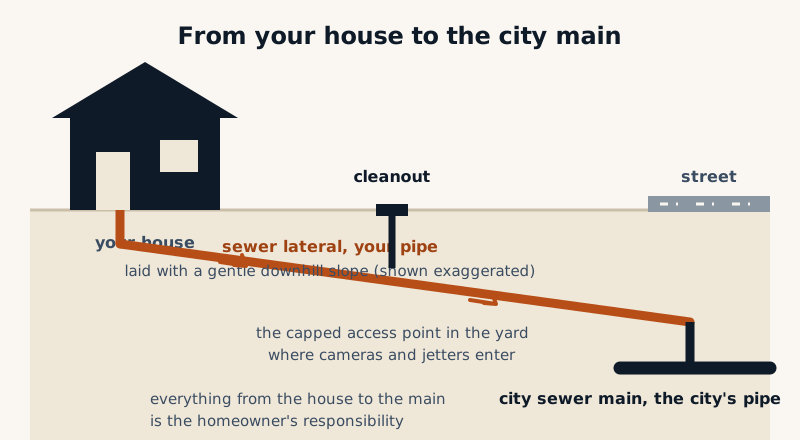
The footage also settles questions of responsibility, which homeowners rarely expect from a plumbing tool. Where a line crosses toward the street, the recording shows whether the damage sits in the homeowner's lateral or beyond it, and that distinction decides who pays for the repair.
A described opinion can be argued with. A timestamped recording with distances on it mostly ends the argument, which is worth having before anyone starts quoting work.

Why The Footage Changes The Conversation
Before cameras, a sewer diagnosis was a professional's inference, and the homeowner's choice was to trust it or not. The footage ends that arrangement.
When the screen shows roots at thirty-one feet, you are looking at the same evidence the pro is, and the repair conversation becomes a shared reading of a picture instead of a leap of faith in either direction.
The locating half of the service matters as much as the viewing half. The camera head carries a transmitter, and the pro marks its position and depth from above ground, so a finding becomes a flag in your yard.
A sewer camera inspection that ends with footage, measurements and marks has converted an underground unknown into a map, and every later decision, repair, replacement, even a future sale of the house, gets made from that map.
A good report turns that map into an order of operations. Findings get ranked: what threatens the house now, what to watch, what can wait for a planned project. That ranking is the difference between a scary video and a usable plan, and it is where experience earns its fee.
Two viewers can watch the same footage; the one who has watched ten thousand lines will triage it better, and will say plainly which parts are judgment calls.
What A Good Inspection Includes
A complete inspection travels the full line where conditions allow, from the house to the city connection, and says plainly how far the camera got when it cannot.
It is narrated while it happens, recorded for you to keep, and summarized in plain language afterward: what is clean, what is building, what is damaged, and what each finding argues for, from nothing at all to a scoped repair.
It should also leave you with distances. Roots at a joint is an observation; roots at the joint thirty-one feet from the cleanout, two feet inside the property line, is a plan.
If an inspection ends with a recommendation but no footage, no measurements and no marks, you have bought an opinion. The tool's whole value is that it replaces opinions with pictures, and the pictures should be yours.
The most common place this evidence gets used is not a repair at all, but a purchase: the companion guide explains why buyers of older homes order a sewer scope before closing, and how to read the one you get.